The Fatal Cost of Cutting Corners at Height: Lessons from a 13-Metre Fall
Gravity is unforgiving, and the margin for error when working at heights is absolute zero. A recent SafeWork NSW Incident Information Release from March 2026 has once again brought this devastating reality to the forefront of the construction industry. A 37-year-old worker tragically lost his life after falling approximately 13.1 metres through a box gutter and associated metal sump on a building under construction.
This catastrophic event is a sobering reminder that "just a quick job" or "stepping carefully" are not valid risk control measures. Working at heights remains one of the leading causes of death and serious injury in Australian workplaces. When we examine the mechanics of these incidents, they rarely stem from a complete absence of safety equipment; rather, they occur due to a failure in the planning phase, an over-reliance on lower-order controls, or a fundamental misunderstanding of what constitutes a safe working environment.
In this comprehensive breakdown, we will examine the critical lessons from this incident, focusing on the strict requirements for edge and void protection, the proper application of fall restraint versus fall arrest systems, and the non-negotiable licensing and operational standards for Elevated Work Platforms (EWPs). For any Person Conducting a Business or Undertaking (PCBU), understanding and implementing these requirements is not just about avoiding fines—it is about ensuring every worker goes home to their family.
The Illusion of a "Safe" Roof: Understanding Non-Trafficable Surfaces
One of the most insidious hazards in roof construction is the presence of non-trafficable surfaces. A roof may look solid, but elements like box gutters, skylights, metal sumps, and brittle flashings are not designed to bear the dynamic load of a human being, let alone a worker carrying tools and materials.
In the recent SafeWork NSW incident, the worker fell through a box gutter. These drainage structures are often perceived as solid pathways or convenient places to step while navigating a pitched or complex roof structure. This is a fatal misconception. Until a competent person—such as a structural engineer or a highly experienced works supervisor—has explicitly verified that the trafficable roof structure, including all plumbing and drainage support systems, is installed strictly in accordance with the design, no worker should be accessing those areas without secondary protection.
Site managers must implement designated, structurally sound walkways that route workers away from penetrations, voids, and brittle materials. If a worker must interact with a non-trafficable element, the hierarchy of control dictates that we must fundamentally change how the work is approached.
Edge and Void Protection: The First Line of Defence
When we talk about height safety, the conversation must always start with passive fall prevention. This means engineering the environment so that a fall is physically impossible, regardless of worker behaviour. This is where robust edge and void protection comes into play.
A void is any opening that a person could fall through. This includes incomplete flooring, skylight openings, lift shafts, and, crucially, the spaces left for box gutters before they are fully structurally supported. Penetration and void controls must be considered during the project concept planning and at every subsequent stage of construction.
Non-Negotiable Void Protection Standards:
- Fit for Purpose: A piece of flimsy plywood thrown over a hole with "HOLE" spray-painted on it is not void protection. Covers must be structurally rated to withstand the specific construction loads they might encounter—this includes the weight of workers, tools, and potentially heavy materials being staged nearby.
- Secured and Labelled: Void covers must be mechanically fixed so they cannot be accidentally kicked or lifted away by a worker who doesn't realise what lies beneath. They must also be clearly and unmistakably labelled.
- Guardrails: Physical edge protection, such as rated guardrails, must be installed around all penetrations, voids, and exposed edges. These rails must meet Australian Standards for height and load-bearing capacity.
- Mesh and Netting: Where solid covers or guardrails are not reasonably practicable during a specific phase of work, heavy-duty safety mesh installed beneath the roofing material can provide a critical safety net.
Fall Restraint vs. Fall Arrest: Knowing the Difference
SafeWork NSW explicitly states that lower-order control measures, such as harness-based systems, are designed to be used only until covers or physical edge protection can be installed. They are not a substitute for proper engineering controls. However, when harnesses must be used, there is a critical distinction between Fall Restraint and Fall Arrest that site supervisors must enforce.
Fall Restraint Systems (Prevention)
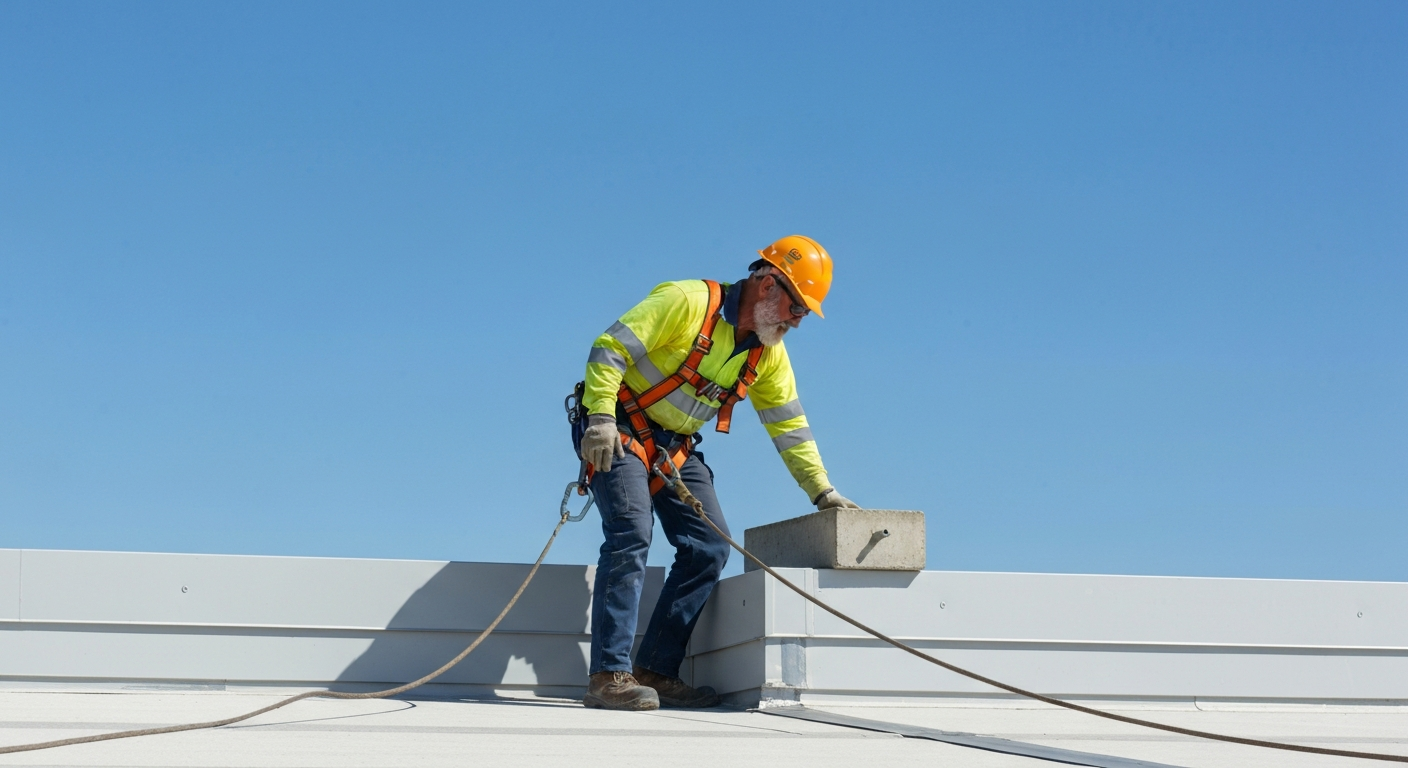
A fall restraint system is essentially a leash. It consists of an anchorage point, a lanyard of a fixed and carefully calculated length, and a full-body harness. The purpose of a restraint system is to physically prevent the worker from reaching the unprotected edge or void. If the worker slips, they hit the deck, but they cannot go over the edge. This is the preferred method when harnesses are required because it eliminates the fall entirely.
Fall Arrest Systems (Mitigation)
A fall arrest system is designed to catch a worker after they have fallen over the edge. This is a measure of last resort. Fall arrest systems require complex calculations regarding fall clearance (ensuring the worker doesn't hit the ground or an obstacle before the system arrests the fall) and the pendulum effect (swinging into structures).
Furthermore, if a worker falls in a fall arrest system, they are immediately subjected to suspension trauma. Blood pools in their legs, and if they are not rescued rapidly (often within 10 to 15 minutes), the situation can become fatal even if the fall itself didn't cause severe injury. If your site relies on fall arrest systems, you are legally required to have a specific, documented, and tested rescue plan in place. Calling 000 is not a rescue plan.
EWPs and the Licensing Trap
In their incident release, SafeWork NSW highlighted a crucial preventative measure: "Ensure box gutters and sump flashings are installed from suitable elevated work platforms (EWPs) or scaffolds."
Working from underneath using an EWP eliminates the risk of falling through the roof structure. However, the introduction of EWPs brings its own set of strict compliance and licensing requirements that businesses often run afoul of.
EWP Licensing Requirements in Australia
You cannot simply hand the keys of an EWP to a worker and tell them to go up. The legal requirements are strict:
- High Risk Work Licence (Class WP): If you are operating a boom-type EWP where the boom length is 11 metres or more, the operator must hold a valid National High Risk Work Licence (Class WP). Operating without this is a severe breach of WHS law.
- EWPA Yellow Card: For scissor lifts, vertical lifts, and boom lifts under 11 metres, while a High Risk Work Licence is not legally mandated, the PCBU still has a primary duty of care to ensure the operator is trained and competent. The industry standard for demonstrating this competency is the EWPA (Elevated Work Platform Association) Yellow Card.
- Harnesses in EWPs: In a boom-type EWP, a full-body harness with a short restraint lanyard attached to the engineered anchor point in the basket is mandatory. This prevents the worker from being catapulted out of the basket if the machine travels over uneven ground or is struck. (Note: Harnesses are generally not required in scissor lifts unless specified by the manufacturer or site rules, as the risk is different).
The SWMS Reality Check
None of the controls mentioned above matter if they only exist in theory. A Safe Work Method Statement (SWMS) for high-risk construction work (which includes any work where a person could fall more than 2 metres) must be highly specific to the site and the task.
Generic, copy-pasted SWMS are a major red flag for regulators. Your SWMS must clearly identify the specific fall hazards on that exact roof—including penetrations, voids, and non-trafficable plumbing components. It must explicitly state the control measures to be implemented, who is responsible for implementing them, and the supervision required to ensure compliance. Crucially, access to the roof area must be strictly controlled until the works supervisor has verified that all controls dictated by the SWMS are actively in place.
The Business Cost and Legal Liability
The human cost of a 13-metre fall is immeasurable. Families are shattered, and workmates are left dealing with lifelong trauma. But PCBUs and site managers must also understand the brutal legal and financial realities of failing to manage height safety.
Under the WHS Act, the failure to provide a safe working environment carries catastrophic penalties. We are increasingly seeing regulators pursue Industrial Manslaughter charges where gross negligence leads to a worker's death. Even outside of manslaughter charges, Category 1 offences for reckless conduct can result in multi-million dollar fines for the corporation, and significant fines and potential jail time for individual directors and officers.
When you juxtapose the cost of hiring a scissor lift or installing temporary edge protection against a $3,000,000 fine and the loss of a human life, the argument that safety is "too expensive" or "takes too long" completely disintegrates.
Conclusion: Zero Tolerance for Height Risks
The tragic loss of a 37-year-old worker in NSW is a stark reminder that gravity does not grant second chances. As an industry, we must move past the mindset of relying on workers to simply "be careful" around voids and edges.
True safety requires robust engineering—installing box gutters from EWPs, implementing rated void covers, erecting proper edge protection, and strictly enforcing fall restraint protocols when passive prevention is impossible. It requires comprehensive planning, site-specific SWMS, and a culture where no worker steps onto a roof until a competent supervisor has verified it is safe to do so.
Height safety is not a paperwork exercise; it is the physical barrier between a worker and a fatal impact. It's time we treat it with the uncompromising respect it demands.